Project Overview
AI-Driven Data Migration Between Old and New Systems
AI Development
Data Analytics
Project Overview
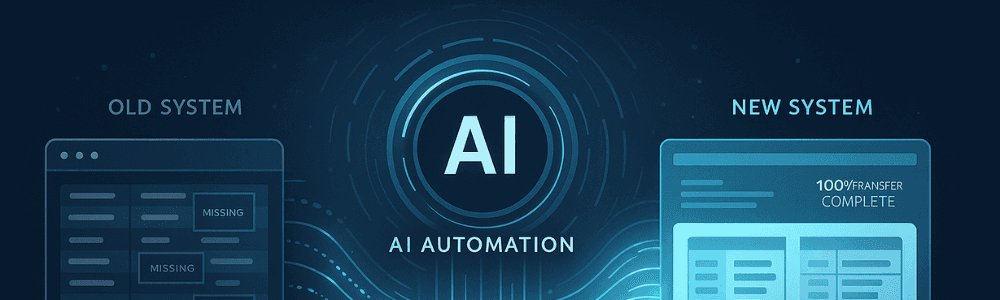
The client was transitioning from an outdated operational system to a modern platform for managing logistics and production data. The old system held thousands of records with inconsistent formats, missing values, and outdated identifiers.
Manual transfer would have required weeks of repetitive work and posed a high risk of human error. The project aimed to automate the entire data migration process using AI and validation algorithms to accelerate implementation while maintaining full data integrity.
Problem Statement
The legacy system stored critical operational data but lacked standardized structure, making migration complex and error-prone. Key challenges included:
Inconsistent field formats and missing identifiers.
Large data volume causing time-intensive manual input.
High dependency on staff for validation and entry.
Risk of data loss or corruption during transfer.
A robust, AI-supported migration process was required to ensure all historical and operational data could be transferred accurately and efficiently to the new system.
Solution
We developed an AI-assisted migration pipeline capable of automatically mapping, cleaning, and transferring data. The system:
Used AI models to detect field correlations and match old data structures to new database schemas.
Applied data validation algorithms to identify duplicates, missing entries, or inconsistencies before transfer.
Automated the transfer execution through API and SQL-based scripts, enabling large-volume uploads without user input.
Included a smart audit process, comparing pre- and post-transfer data for accuracy and completeness.
This minimized downtime and allowed the new system to go live faster, with all historical data validated and aligned.
Result
Complete data migration completed in a fraction of the estimated time.
Over 90% reduction in manual workload, freeing staff for training and system familiarization.
Zero data loss confirmed through AI validation and post-migration audits.